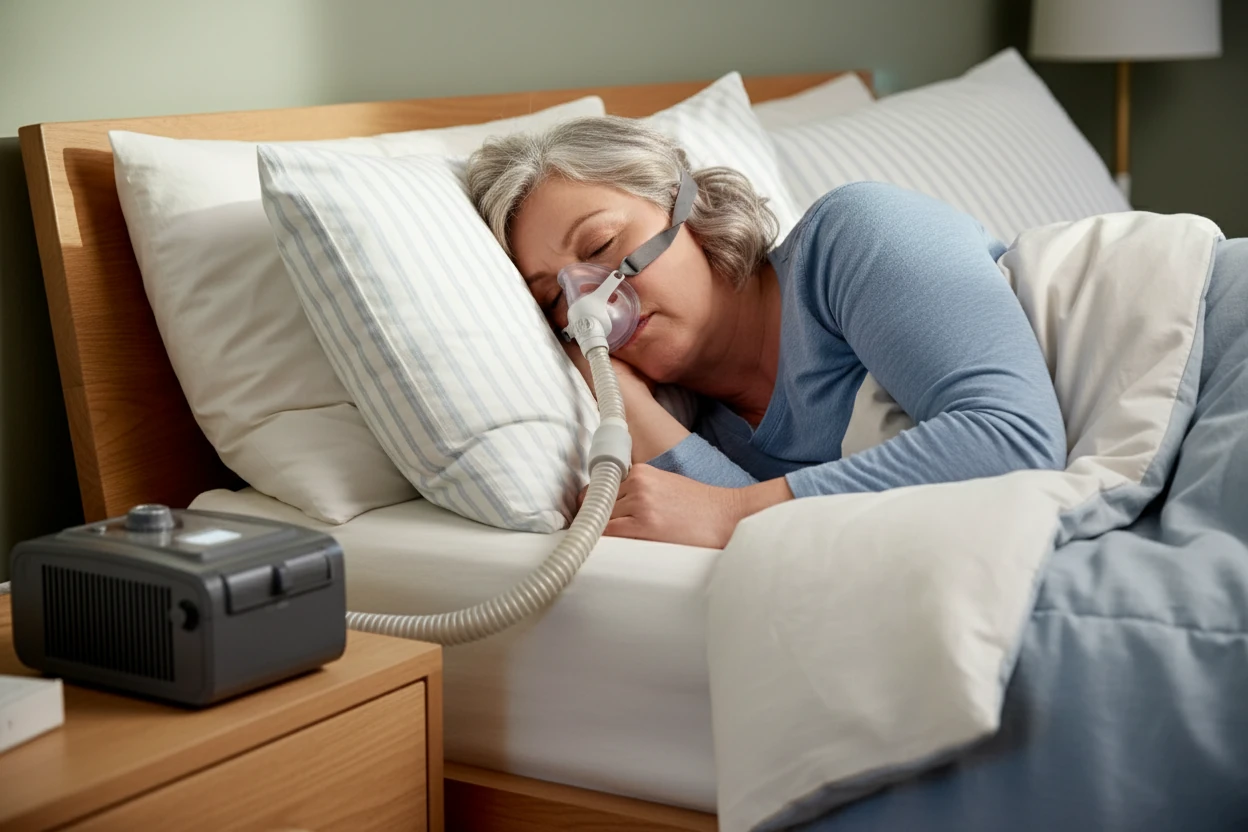
Long COVID affects nearly one in four people who have had COVID-19, with symptoms sometimes lasting for years after infection1 . Sleep disturbances, including insomnia and hypersomnia, are common in long COVID and can significantly reduce quality of life2 . Obstructive sleep apnea (OSA), a widespread but often undiagnosed sleep disorder, has emerged as a notable risk factor for developing long COVID symptoms3 4. Understanding the link between sleep apnea and long COVID is crucial for improving patient care and outcomes.
Sleep Apnea and Long COVID Risk
Obstructive sleep apnea (OSA) is a prevalent disorder characterized by repeated upper airway collapse during sleep, leading to intermittent hypoxia (low oxygen levels) and sleep fragmentation5 . It affects nearly one billion adults worldwide, making it a major public health issue3 . Recent large-scale studies have shown that adults with OSA who contract COVID-19 are significantly more likely to develop long COVID symptoms compared to those without OSA4 6.
A comprehensive analysis of electronic health records from over 2.2 million Americans found that adults with preexisting OSA had up to a 75% higher risk of experiencing long COVID6 . This increased risk persisted even after adjusting for factors such as age, sex, obesity, hospitalization during acute COVID-19, and other comorbidities7 8. In one large cohort, adults with OSA were 75% more likely to have long COVID, while another cohort showed a 12% increased risk4 7.
Women with OSA showed an even higher likelihood of developing long COVID compared to men, with an 89% increased risk versus 59% for men in one study8 . This sex difference may reflect underdiagnosis of OSA in women, leading to more severe cases being documented8 .
In contrast, studies in children found no significant association between OSA and long COVID after adjusting for obesity and other factors4 8. This suggests that the increased risk linked to OSA may be more relevant in adult populations.
- Obesity
- Cardiovascular disease
- Older age
- Male gender
- Preexisting chronic pulmonary disease
These overlapping risk factors complicate the relationship but highlight populations that may benefit from closer monitoring after COVID-19 infection2 15.
Adults with obstructive sleep apnea face a markedly increased risk of long COVID, with some studies showing up to a 75% higher likelihood of persistent symptoms after COVID-19 infection. Women with OSA may be especially vulnerable6 78.
Connection Between Sleep Apnea and Long COVID
Long COVID is a complex condition with symptoms that can persist for weeks, months, or even years after the initial SARS-CoV-2 infection1 . It manifests in various clinical subtypes, including mild neuromuscular, mild respiratory, and severe multi-organ forms, with the latter associated with persistent and debilitating symptoms1 . Sleep disturbances are a core feature of long COVID, including insomnia, hypersomnia, and mixed sleep phenotypes2 .
OSA contributes to these sleep disturbances through its hallmark features of intermittent hypoxia and sleep fragmentation5 . These physiological effects may exacerbate the inflammatory and immune responses triggered by COVID-19, potentially worsening long COVID symptoms2 5.
Shared risk factors such as obesity and cardiovascular disease further link OSA and long COVID2 . Chronic intermittent hypoxia from OSA activates inflammatory pathways, including nuclear factor-kappa B and toll-like receptor-4, increasing levels of pro-inflammatory cytokines like tumor necrosis factor-alpha (TNF-α) and interleukin-6 (IL-6) 9. These inflammatory mediators are also elevated in long COVID, suggesting a common biological pathway9 .
Sleep disturbances in long COVID are often accompanied by other comorbidities such as anxiety, depression, and chronic pain, which also increase the risk of persistent symptoms2 . The exact mechanisms connecting OSA and long COVID remain under investigation, but inflammation and hypoxia are leading hypotheses2 5.
- Intermittent hypoxia worsens systemic inflammation5 9
- Sleep fragmentation disrupts restorative sleep, impairing immune function2
- Shared comorbidities increase vulnerability to severe COVID-19 and prolonged recovery1
- Elevated inflammatory markers in OSA overlap with those found in long COVID9
Part of the challenge is that many of the risk factors for sleep apnea are also risk factors for COVID-19 outcomes, emphasizing the complexity of the association8 .
Research Advances in Long COVID
Recent research has advanced understanding of the relationship between OSA and long COVID, highlighting the importance of sleep disturbances in post-COVID recovery2 4. Large cohort studies using electronic health records have provided robust evidence that OSA independently increases the risk of severe COVID-19 and long COVID, even after adjusting for confounding factors10 4.
Sleep disturbances are highly prevalent in long COVID, with insomnia reported in approximately 35% of patients, hypersomnia in 9%, and mixed sleep phenotypes in over 20% 2. Comorbidities such as chronic heart disease, OSA, and chronic pulmonary disease are specifically linked to mixed sleep disturbance phenotypes, which are associated with more severe long COVID symptoms2 .
The biological pathways underlying these associations are not fully established, but intermittent hypoxia and systemic inflammation caused by OSA are thought to exacerbate post-COVID sequelae2 5. Genetic studies also suggest shared susceptibility factors between OSA and severe COVID-1911 .
We still have a lot to learn about the long-term effects of this virus, but this study could inform clinical care by identifying patients who may benefit from closer monitoring6 .
- Preexisting sleep disturbances increase the risk of COVID-19 susceptibility, hospitalization, mortality, and long COVID12
- OSA is a significant risk factor across the entire clinical course of COVID-19, including long COVID12 13
- Age and sex modify the impact of sleep disturbances on COVID-19 outcomes, with younger individuals showing higher susceptibility but lower mortality, and males showing higher mortality risk12
- Insomnia and abnormal sleep duration also increase long COVID risk12
Treatment adherence, such as continuous positive airway pressure (CPAP) therapy for OSA, may influence COVID-19 outcomes, but its protective role against long COVID remains unclear and requires further study14 15.
| Sleep Disturbance | COVID-19 Susceptibility | Hospitalization Risk | Mortality Risk | Long COVID Risk |
|---|---|---|---|---|
| Obstructive Sleep Apnea | Increased12 | Increased12 | Increased12 | Increased12 |
| Insomnia | Not significant12 | Not significant12 | Not significant | Increased12 |
| Abnormal Sleep Duration | Increased12 | Increased12 | Not significant | Increased12 |
| Night-Shift Work | Increased12 | Increased12 | Not significant | Not significant |
| Sources: 12 | ||||
A strength of the work is that the link between sleep apnea and long COVID persisted regardless of how the researchers in our study defined long COVID or gathered data7 .
- Screening for OSA in COVID-19 patients may identify those at higher risk for long COVID4
- Close monitoring and early intervention could improve outcomes in patients with OSA and COVID-196
- Maintaining vaccination and adherence to OSA treatment is recommended to reduce infection risk and severity6 8